
ERW vs LSAW vs SSAW: A Comparison Guide to Welded Carbon Steel Pipe Selection
ERW, LSAW and SSAW are three seam constructions inside one product family: welded carbon steel pipe. At Solid Steel Pipes (Shanxi Solid Industrial Co., Ltd.), a Shanxi, China based manufacturer and exporter of steel pipes, pipe fittings and flanges, all three are quoted against a single published dimensional envelope — outside diameter 6 mm to 3000 mm, wall thickness 4 mm to 18 mm, and standard lengths of 6 m, 9 m and 12 m, with other lengths produced according to the contract. The same envelope is offered under GB, SY, DIN, ASTM, ASME, ANSI and API standards, with plain or beveled ends, and beveled ends can be protected by plastic pipe caps.
That shared envelope is exactly why this comparison is necessary. Because dimensions, standards and end finishes overlap across the three types, a buyer cannot choose between ERW, LSAW and SSAW on price per ton alone. The decision has to be made on what the line carries, which standard governs the order, and which documentation the receiving project will accept.
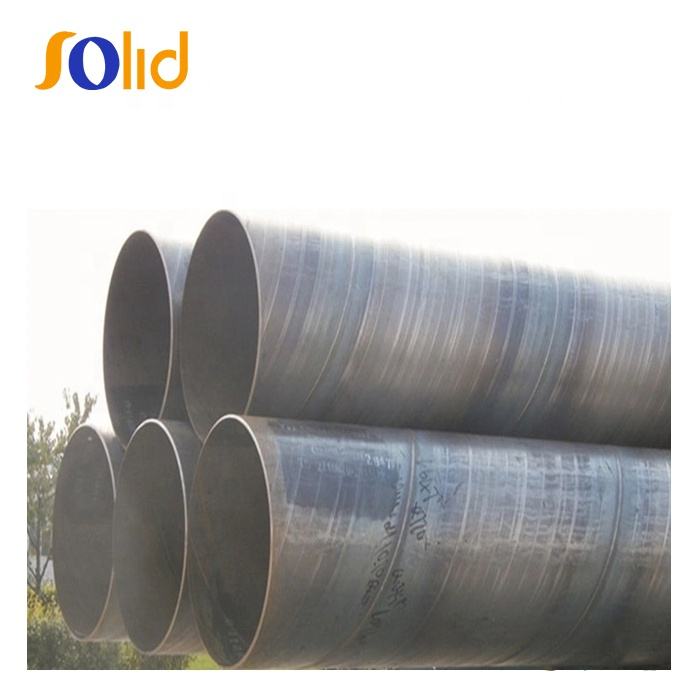
SSAW welded pipe — spiral submerged arc welded carbon steel pipe, one of the three seam types in the welded carbon steel pipe family.
The Core Problem: One Product Name, Three Different Seams
When a requisition says “welded carbon steel pipe, 12 m, beveled ends”, three mills can answer with three different products. One quotes ERW, one quotes LSAW, one quotes spiral welded steel pipe. The dimensional data matches, the length matches, the end finish matches — and a comparison table that only reads price looks complete while the three offers are technically different products.
The practical consequence is that a buyer may approve a weld type without ever deciding it. This usually surfaces later, during inspection, during welding on site, or at the customs entry stage where the trade classification produces a different tariff line than the one used in the landed-cost estimate.
Six things change when the seam type changes, and each of them belongs in the evaluation, not only in the quotation:
- Seam geometry. A straight longitudinal seam and a helical seam are not inspected the same way, and they do not present the same weld length to the pipe body.
- Forming input. Strip-fed and plate-fed processes place different practical limits on what can be produced at the top and bottom of the diameter envelope.
- Standards route. The governing standard is chosen by application and market, and it must be stated on the order together with its edition.
- Documentation. Inspection records, certificate references and declaration of conformity must match the standard route that was ordered.
- End finish. Plain or beveled ends determine how the pipe is joined and how it must be packed.
- Adjacent components. Pipe is normally bought with fittings, flanges and couplings, so the pipe specification and the fitting specification have to line up before the order is placed.
The decision rule in one sentence: choose the seam type that the governing standard and the service condition allow, then choose the standard route that your market accepts, then confirm the end finish and the documentation — in that order. Price is the last variable, not the first.
Industry Background: Where Welded Carbon Steel Pipe Sits
Carbon steel is the default material for pipe in industrial and infrastructure work. According to Fortune Business Insights, carbon steel pipes held a 78.0% share of the global steel pipe market in 2026, and the same research projects the global steel pipe market to reach USD 109.72 billion by the end of 2026. The same source attributes the largest technology segment to seamless pipe, with over 66.0% share in 2025.
Those figures matter for this comparison because they set the expectation correctly. Welded pipe is not a substitute for seamless pipe; it is a separate product family with its own standards, its own dimensional envelope and its own inspection logic. Seamless pipe covers applications where a homogeneous body is required, and ASTM A106 is the standard most often named for that route: it covers seamless carbon steel pipe for high-temperature service in NPS 1/8 to NPS 48, with nominal wall thickness as given in ANSI B36.10.
Welded pipe is specified where the line is defined by diameter, length, delivery schedule and jointing method. On the standards side, the welded family at Solid Steel Pipes is produced to GB, SY, DIN, ASTM, ASME, ANSI and API, with ASTM and API listed among the standards in the welded product specification. API 5L is the core specification for oil and gas transmission mainline pipelines and typically uses grades X65, X70 and X80 for high-pressure trunk lines. API 5L covers both seamless and welded line pipe for conveying gas, water, oil and other liquefied media, and it includes two product specification levels, PSL1 and PSL2.
Regulatory references decide whether a standard is merely accepted or actually mandatory. In the United States, 49 CFR Part 192 Appendix B identifies both API Specification 5L and ASTM A106/A106M among the incorporated pipe specifications for covered pipeline applications. That reference is jurisdiction-specific and should not be generalised to other markets, but it illustrates the principle: the standard cited in the requisition has to match the standard cited by the regulator.
For the EU market, CE certification adds a conformity layer on top of the standard. Solid Steel Pipes holds CE certification number 6G260727.SSIQ015, issued by Ente Certificazione Macchine (ECM), covering steel pipes, fittings and flanges, with an issue date of 27 July 2026 and an expiry date of 26 July 2031. The standards referenced in that certificate include EN 10217, EN 10210, EN 10255, BS 1387, API 5L, ASTM A53, ASTM A106 and ASME B16.9.
Trade classification is the third layer. Under the UN Comtrade Harmonized System reference table, HS 7304 covers seamless tubes, pipes and hollow profiles of iron or steel. HS 7305 covers non-seamless circular tubes and pipes with an external diameter exceeding 406.4 mm. HS 7306 covers other non-seamless tubes, pipes and hollow profiles, including welded products. The three headings have different scopes and must not be combined into one trade category, because a supplier-country comparison built on mixed headings produces a volume conclusion that is simply wrong.
ERW, LSAW and SSAW Defined
The three abbreviations describe how the seam is made, and that is the only stable difference between them at the product-family level.
ERW — Electric Resistance Welded
In ERW pipe, coiled steel strip is formed into a cylinder and the two longitudinal edges are joined by electrical resistance welding along a straight seam that runs the full length of the pipe. The seam is longitudinal, the forming input is strip, and the resulting product is the conventional choice for small and medium bore welded carbon steel pipe used in water supply, structural and general industrial service.
LSAW — Longitudinal Submerged Arc Welded
LSAW pipe is formed from plate and welded along a straight longitudinal seam using the submerged arc process with filler metal. Because it starts from plate rather than narrow strip, LSAW is the usual route when a straight seam is required at larger diameters and heavier wall thickness, which is why it appears in transmission and structural work where a single longitudinal weld is preferred for inspection.
SSAW — Spiral Submerged Arc Welded
SSAW pipe, also sold as spiral welded steel pipe, is formed by feeding strip or plate at an angle so that the seam runs helically around the pipe body, then welding that seam with the submerged arc process. The helical geometry lets a large finished diameter be produced from narrower input stock, which is why spiral welded steel pipe is common in large-diameter water mains, pipeline steel pipe runs and piling work.
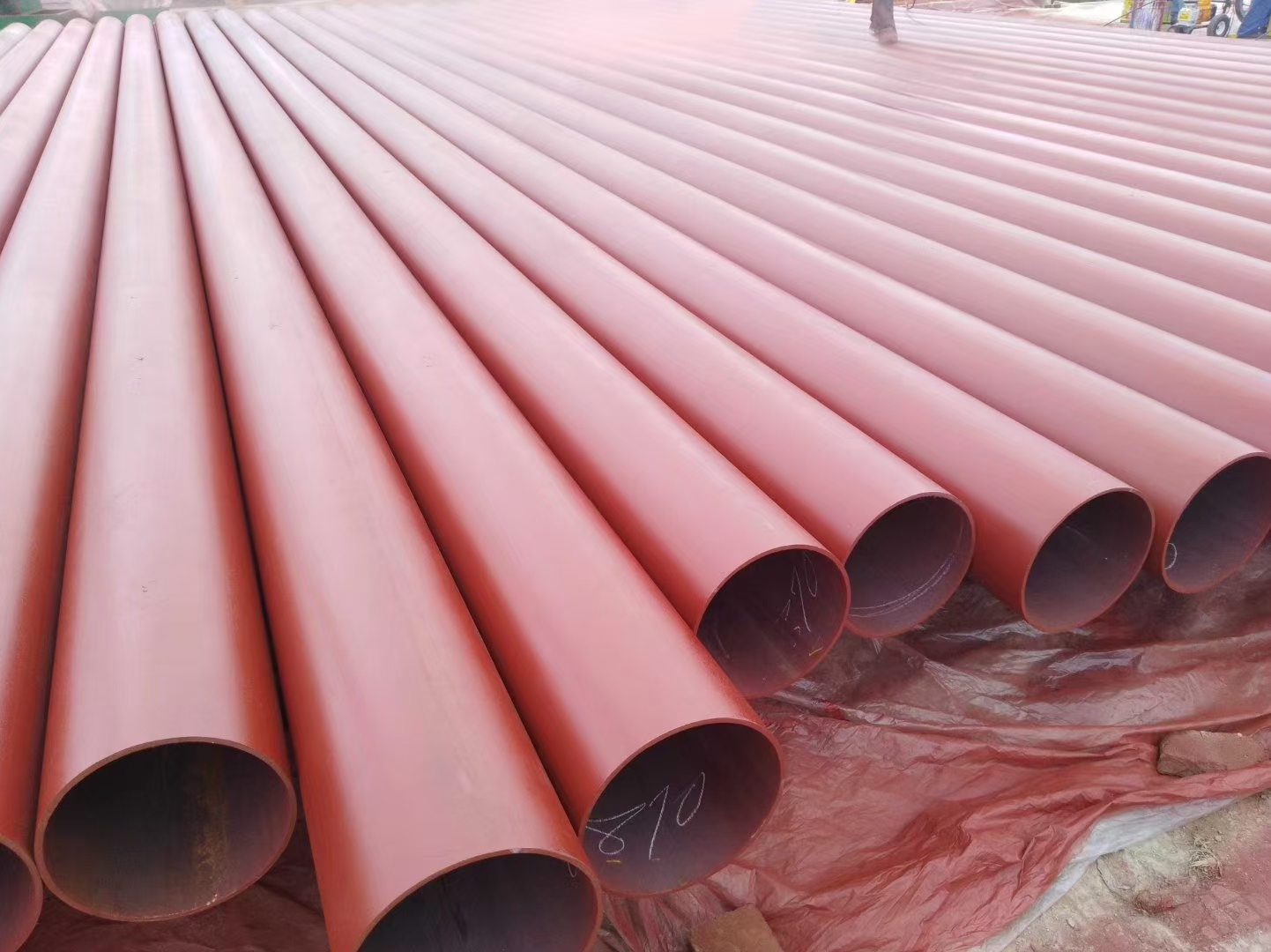
LSAW welded pipe — a straight longitudinal submerged arc seam, produced from plate.
The descriptions above are general process characteristics. They are not project approvals. The commercially binding statement for any order is the specification agreed in the quotation and confirmed against the applicable standard, and the type-specific availability at a given diameter and wall thickness should be confirmed with the mill before the requisition is frozen.
The Shared Specification Envelope
All three weld types are offered inside one envelope, and this is the part of the specification that does not change when the buyer switches between ERW, LSAW and SSAW.
| Parameter | Specification for the welded carbon steel pipe family |
|---|---|
| Seam types | ERW Welded Pipe, LSAW Welded Pipe, SSAW Welded Pipe |
| Material | Carbon steel |
| Outside diameter | 6 mm to 3000 mm |
| Wall thickness | 4 mm to 18 mm |
| Length | 6 m / 9 m / 12 m, or other size according to the contract |
| Standards | GB, SY, DIN, ASTM, ASME, ANSI, API |
| Ends | Plain or beveled; beveled ends can be protected by plastic pipe cap |
| Intended industry | Architecture and infrastructure |
Outside diameter and wall thickness are the dimensional parameters stated in the product specification, and they are the two values that must be fixed first. Everything else in the selection — seam type, standard, inspection level, packing — is downstream of those two numbers plus the length.
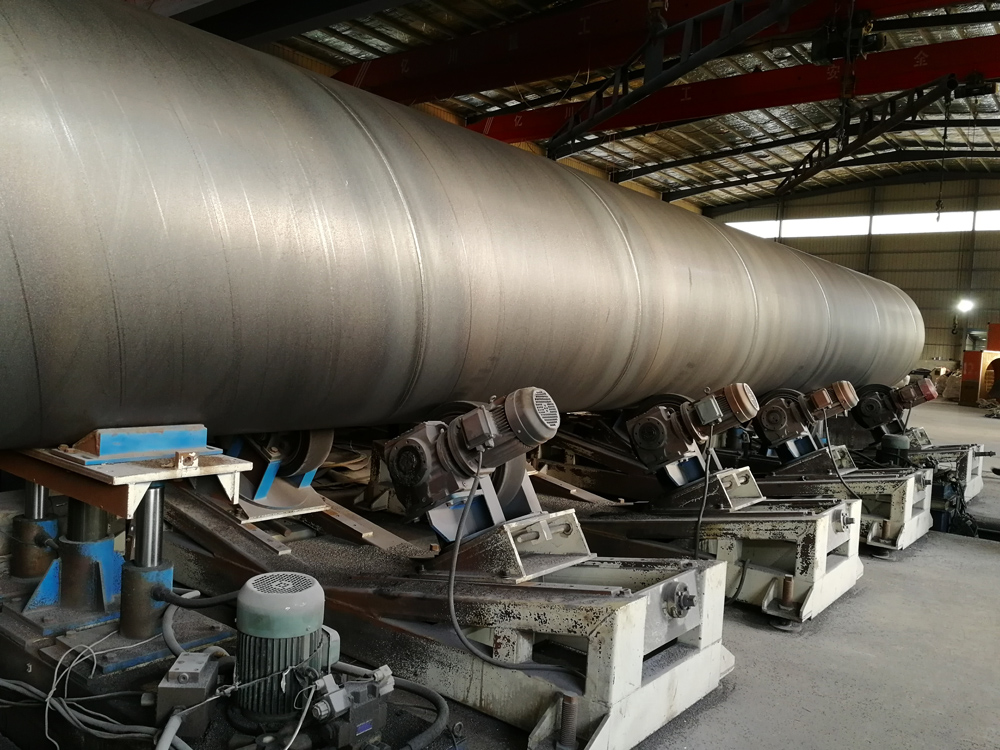
Large-diameter spiral welded steel pipe — the upper end of the shared outside diameter envelope, where seam type selection has the greatest commercial effect.
Step-by-Step: How to Select the Right Weld Type
The sequence below is the order in which the variables actually constrain each other. Working through it prevents a buyer from selecting a seam type before the service condition is known.
Step 1 — Fix the service condition, not the product name
Start with the medium, the temperature, the pressure basis and the installation method. Steel pipes are generally suitable for temperatures from -30 °C to 120 °C, and they must be kept away from strong acid and strong alkali media and from temperatures above 120 °C. Installation may be horizontal, vertical, on a slope or above ground, and each of those affects how the pipe is handled and jointed rather than which seam it has — but they all belong in the technical annex.
Step 2 — Lock outside diameter, wall thickness and length
Anchor the requisition to the drawing: outside diameter within 6 mm to 3000 mm, wall thickness within 4 mm to 18 mm, and length specified as 6 m, 9 m or 12 m, unless a contract length is agreed. At this point the buyer knows whether the line sits at the lower or the upper end of the envelope — which is the single most useful input into the seam decision.
Step 3 — Match the seam type to the function
ERW, LSAW and SSAW are all available inside the same envelope, so the choice is about fitness rather than feasibility. Three working rules keep the decision honest:
- Where the line is small or medium bore and the jointing method is conventional, ERW is the usual starting point.
- Where a straight longitudinal seam is preferred at larger diameter and heavier wall, LSAW is the usual route.
- Where the diameter is large and the project needs long continuous runs of spiral welded steel pipe, SSAW is the usual route.
- In every case, confirm with the mill which of the three types is available at the exact diameter and wall thickness before the specification is frozen.
Step 4 — Set the standards route and the documentation package
GB and SY are the Chinese domestic routes; DIN serves European project specifications; ASTM, ASME and ANSI serve North American practice; API governs line pipe. The order should state the standard, the edition, the grade and — where API 5L applies — the product specification level, PSL1 or PSL2. If the pipe ships into the EU, the CE certificate 6G260727.SSIQ015 issued by Ente Certificazione Macchine covers steel pipes, fittings and flanges and references EN 10217, EN 10210, EN 10255, BS 1387, API 5L, ASTM A53, ASTM A106 and ASME B16.9.
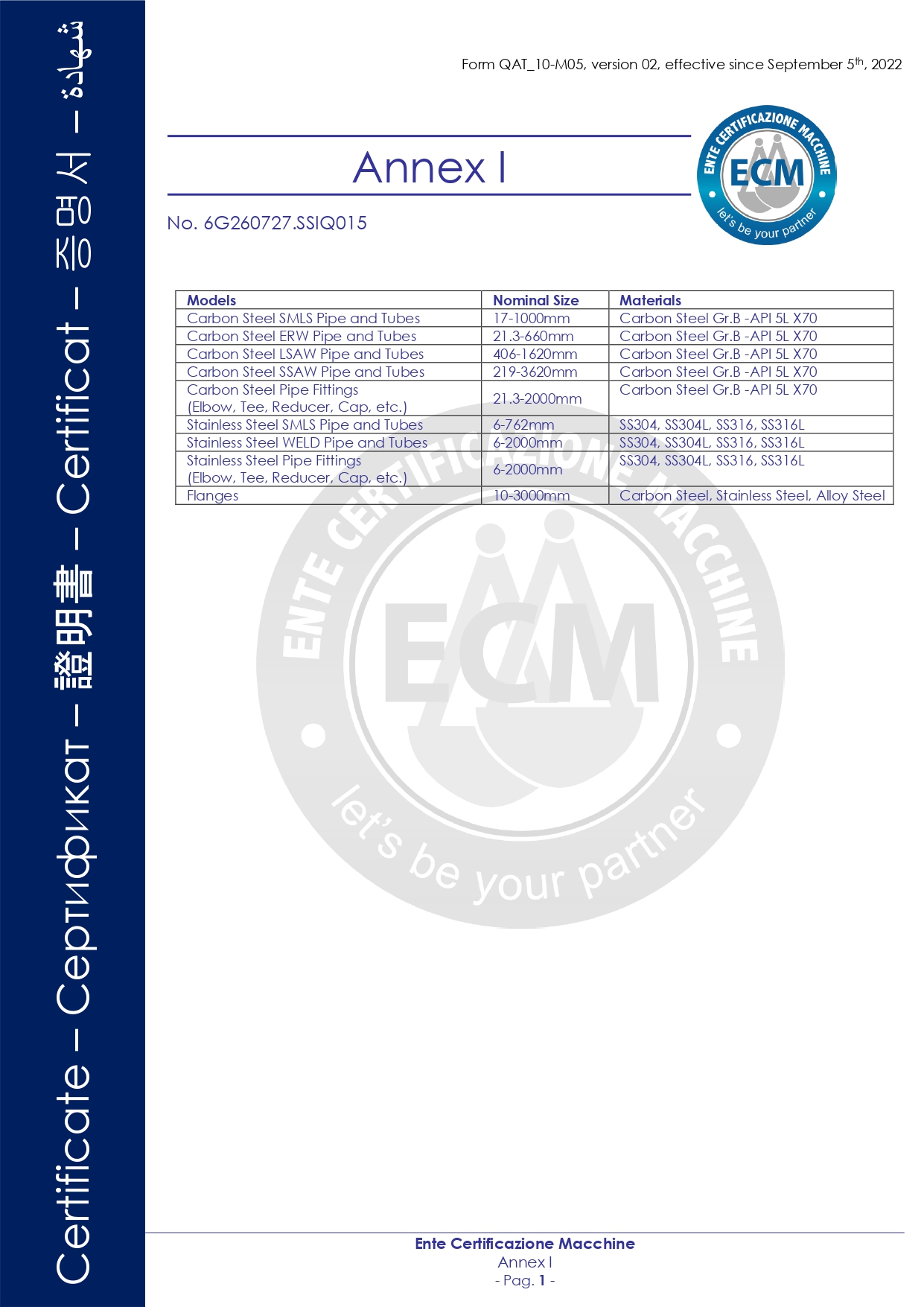
CE certification 6G260727.SSIQ015, issued by Ente Certificazione Macchine (ECM), applies to steel pipes, fittings and flanges for the EU market.
Step 5 — Decide the end finish
Choose plain or beveled ends based on how the pipe will be joined in the field, then decide whether beveled ends need plastic pipe caps for transport protection. This decision belongs on the purchase order, not in a shipping instruction sent after production.
Step 6 — Agree inspection, packing and lead time
Solid Steel Pipes performs 100% pre-shipment test on orders, accepts a minimum order quantity of 1 ton, quotes a lead time of 15–30 days and runs a monthly capacity of 25,000 tons. Customisation covers size, spray coating, standard, material and packaging, which means packing and coating should be specified in the same document as the pipe parameters.
ERW vs LSAW vs SSAW: Side-by-Side Comparison
The table compares the three seam types on the factors that decide an order. Rows where the answer is identical are as important as rows where it differs — they show the buyer where negotiation effort is wasted.
| Decision factor | ERW | LSAW | SSAW |
|---|---|---|---|
| Full name | Electric Resistance Welded | Longitudinal Submerged Arc Welded | Spiral Submerged Arc Welded |
| Seam orientation | Straight, longitudinal | Straight, longitudinal | Helical, spiralling around the body |
| Forming input | Coil strip | Plate | Strip or plate fed at an angle |
| Position in the shared envelope | All three are offered within outside diameter 6 mm to 3000 mm and wall thickness 4 mm to 18 mm; confirm type availability at the exact size before freezing the requisition. | ||
| Standards route | GB, SY, DIN, ASTM, ASME, ANSI, API — identical for all three. | ||
| Lengths | 6 m / 9 m / 12 m, or other size according to the contract. | ||
| Ends | Plain or beveled; beveled ends can be protected by plastic pipe cap. | ||
| Inspection and documentation | 100% pre-shipment test; CE certificate 6G260727.SSIQ015 covers steel pipes, fittings and flanges for the EU market. | ||
| Typical buying situation | Small and medium bore water supply, structural and general industrial service | Larger diameter with a straight longitudinal seam for transmission and structural work | Large diameter spiral welded steel pipe for long pipeline and water main runs |
| HS classification effect | Classification follows the finished outside diameter and seam status, not the weld type: circular non-seamless pipe above 406.4 mm falls under HS 7305, other non-seamless welded pipe under HS 7306. Validate the national subheading before building a landed-cost model. | ||
Note: the seam-type buying situations above are general process characteristics intended for shortlisting. They are not project approvals, and final selection follows the governing standard and the project specification.
Use Cases: Matching Weld Type to Service
Municipal water supply and urban infrastructure
Fluid transportation for buildings and urban infrastructure is the core application of the welded family, with steel pipe fittings as the matched equipment. A recent reference is the Ecuador municipal water supply project, an urban water supply pipeline network upgrade addressing growing domestic water demand from rapid urbanisation. The order totalled 11,896 tons and covered multiple core sizes including 2032, 1219, 1422 and 914, allowing the same supply to serve road sections with different laying requirements and water transmission pressures. The design service life specified for that network was 30–70 years, which is why the pipe was produced as a customised item against the project's water-supply requirements rather than taken from stock.
Petroleum, gas and pipeline transmission
Line pipe is governed by API 5L, which covers seamless and welded line pipe for gas, water, oil and other liquefied media and includes PSL1 and PSL2. High-pressure trunk lines typically use grades X65, X70 and X80. For this application the seam type is only one entry on the specification: the PSL level, the grade and the inspection documents decide whether the offer is acceptable at all.
Building structures and energy pipelines
Welded carbon steel pipe also serves structural support alongside fluid transport, in the temperature band from -30 °C to 120 °C, in horizontal, vertical, slope or above-ground installation. In structural service the governing values are dimensional accuracy and consistency of the seam, because the pipe is a load-bearing element rather than a conduit.
Industrial plant piping and bundled orders
Plant piping rarely buys pipe alone. Steel pipe fittings, carbon steel pipe fittings, steel pipe flanges, forged steel flange items and steel pipe couplings are normally procured together with the pipe, and ASME B16.9 appears in the same CE scope as the pipe standards. Bundling the order reduces interface risk, but only if the pipe specification and the fitting specification are written against the same standard route from the start.
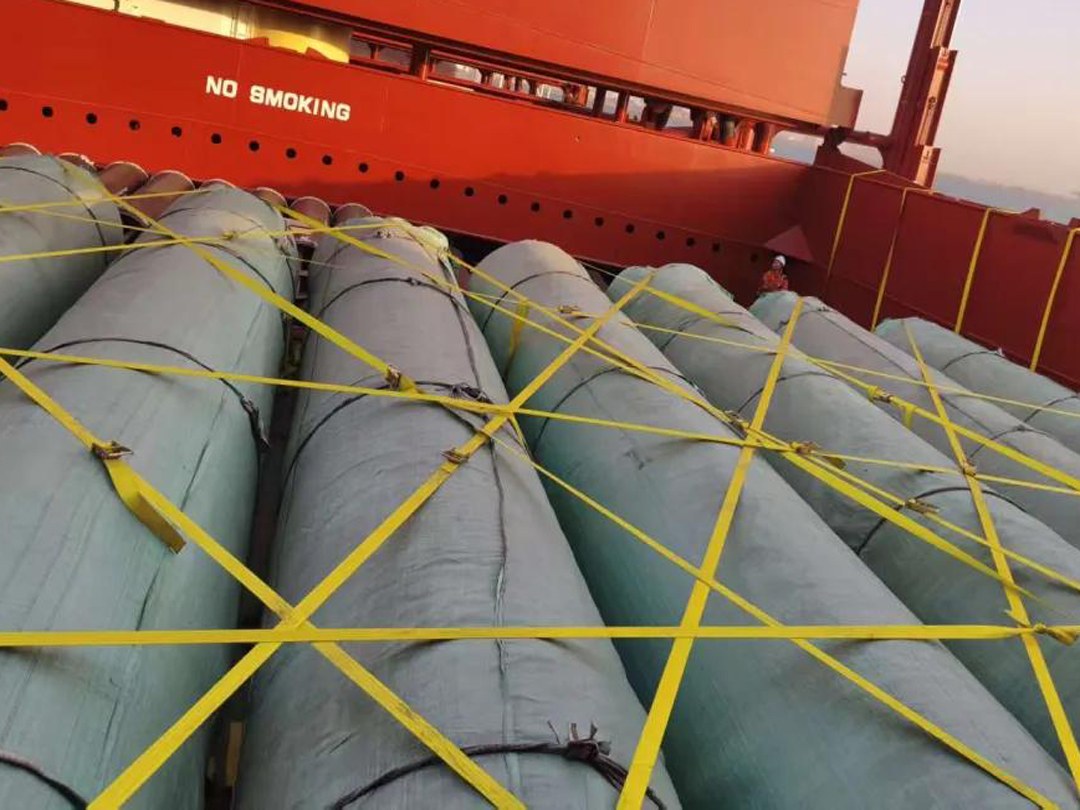
Packaged welded steel pipe loaded for shipment — packing and end protection are agreed before production, not after.
Plain vs Beveled Ends and Plastic Pipe Caps: Decision Checklist
End finish is the last technical decision and the easiest one to lose between the technical annex and the packing list. Beveled ends exist to be welded, so they need protection from the moment the pipe leaves the line until the joint is made. Solid Steel Pipes supplies both plain and beveled ends, and beveled ends can be protected by plastic pipe caps.
- Confirm the joining method on site: field girth welding points to beveled ends; other connection methods may be served by plain ends.
- Confirm the bevel geometry against the governing standard and the project welding procedure before the order is released.
- Confirm that plastic pipe caps are specified on beveled ends for handling, storage and sea freight.
- Confirm who removes the caps and at which inspection point, so the caps do not conceal damage at destination.
- Confirm the end finish is written identically on the purchase order, the packing list and the inspection record.
- Confirm the same end finish logic is applied to fittings and flanges in a bundled order, since mismatched ends create field rework.
- Confirm the standard, the edition, the grade and — for API 5L — the PSL level all appear on the same document as the end finish.
Frequently Asked Questions
1. Which standards can ERW, LSAW and SSAW welded carbon steel pipe be supplied to?
All three seam types are produced to GB, SY, DIN, ASTM, ASME, ANSI and API standards, with ASTM and API listed among the standards in the welded carbon steel pipe specification. For the EU market, CE certificate 6G260727.SSIQ015 issued by Ente Certificazione Macchine (ECM) covers steel pipes, fittings and flanges and references EN 10217, EN 10210, EN 10255, BS 1387, API 5L, ASTM A53, ASTM A106 and ASME B16.9; it was issued on 27 July 2026 and expires on 26 July 2031. Name the standard and its edition in the request for quotation so the offer can be checked against the certificate scope.
2. What should a buyer check when ordering carbon steel pipe with mill test certificates (MTCs)?
Order the standard, not the trade name. ASTM A106 covers seamless carbon steel pipe for high-temperature service in NPS 1/8 to NPS 48, with nominal wall thickness as given in ANSI B36.10, so an A106 requirement points to seamless pipe; a welded order is governed by the welded route — API 5L, ASTM A53, or the GB, SY and DIN standards as specified. API 5L covers seamless and welded line pipe for gas, water, oil and other liquefied media and includes PSL1 and PSL2. The requisition should state the standard and edition, grade, PSL level where API 5L applies, outside diameter, wall thickness, length, end finish and the inspection documents required. Solid Steel Pipes performs 100% pre-shipment test on orders.
3. Can ERW, LSAW and SSAW pipe be customised for an OEM or project order?
Yes. Solid Group operates OEM and ODM production with customisation of size, spray coating, standard, material and packaging, a minimum order quantity of 1 ton, and after-sales support that includes installation guidance, technical support and product warranty. Customised sizes, materials, standards and markings can be produced per customer drawings and brand requirements.
4. What drives the price difference between ERW, LSAW and SSAW pipe?
No list price is published, because a welded carbon steel pipe price is a function of the order. The variables that move the quotation are the outside diameter and wall thickness combination inside the 6 mm to 3000 mm and 4 mm to 18 mm envelope, the length (6 m, 9 m, 12 m or a contract length), the seam type, the standards route and inspection level, the end finish, any coating such as spray coating, the quantity against a 1 ton minimum order quantity, the packing method and the delivery terms. The only reliable comparison is to send identical specifications — same standard, same edition, same grade, same dimensions, same ends, same documents — to every supplier and compare the returned quotations line by line.
5. What is the lead time and production capacity for welded carbon steel pipe orders?
Standard lead time is 15–30 days, supported by a monthly capacity of 25,000 tons and 100% pre-shipment testing. Because lead time starts from specification release rather than from enquiry, the fastest route to a firm date is to send the complete parameter set — diameter, wall thickness, length, seam type, standard, grade, end finish and packing — in the first message, and the team can then confirm availability and schedule against the actual order.
Conclusion: Select in the Right Order
The ERW vs LSAW vs SSAW comparison does not end with a winner, because the three are not competing for the same slot. They share one specification envelope at Solid Steel Pipes — outside diameter 6 mm to 3000 mm, wall thickness 4 mm to 18 mm, lengths of 6 m, 9 m and 12 m or per contract, GB, SY, DIN, ASTM, ASME, ANSI and API standards, plain or beveled ends with plastic pipe caps available — and they divide the work by seam geometry and forming route.
The defensible selection sequence is: fix the service condition and the temperature band, lock the outside diameter, wall thickness and length from the drawing, match the seam type to the function and confirm its availability at that exact size, set the standards route and the documentation package including CE where the EU market applies, then decide plain versus beveled ends and plastic cap protection, and finally agree inspection, packing and lead time. Buyers who follow that order end up comparing like with like. Buyers who start with price end up comparing three different products on one number.
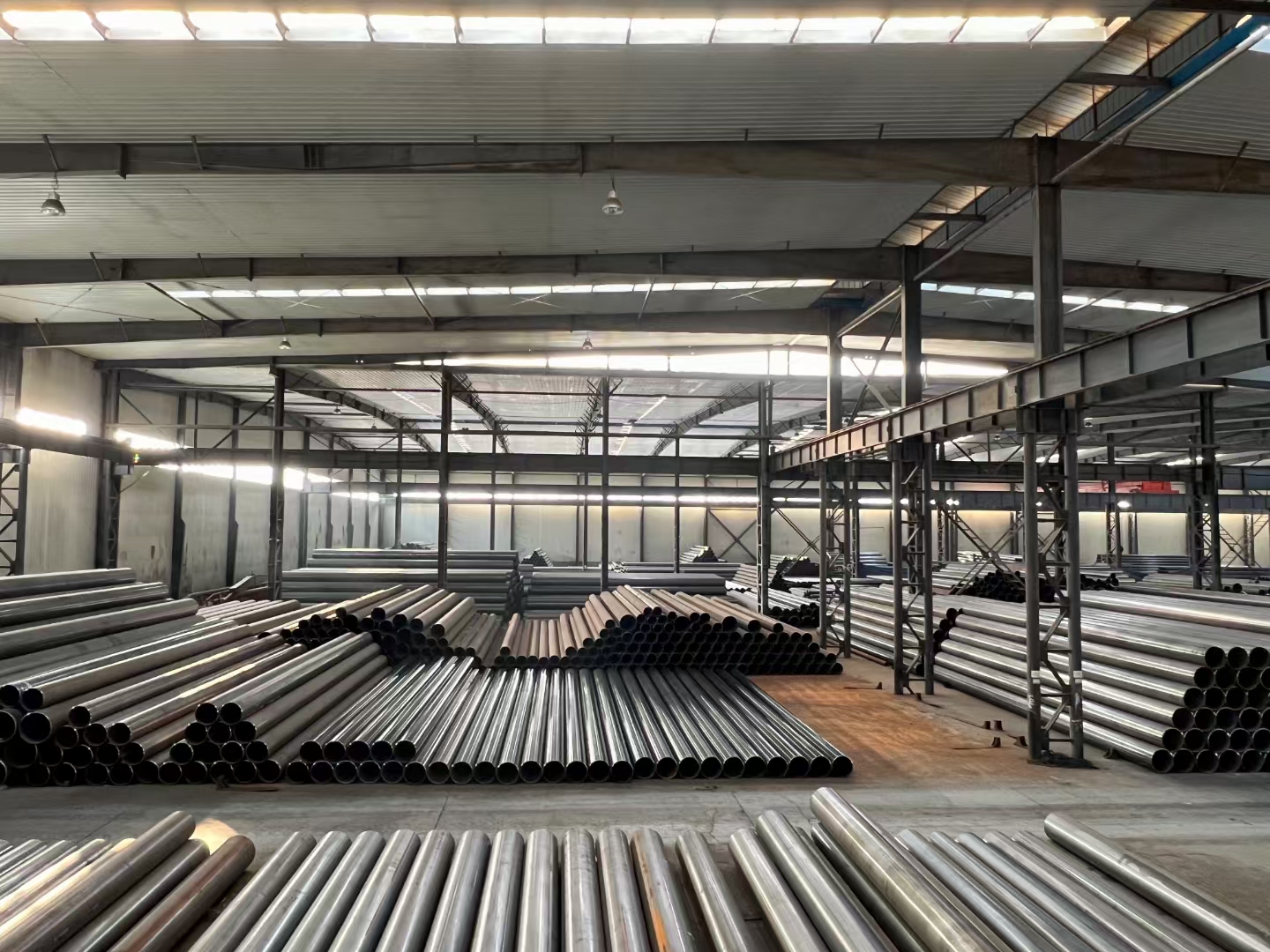
Welded carbon steel pipe in the Solid Steel Pipes warehouse, staged for inspection and dispatch.
Next Step: Send the Specification, Get a Matched Quotation
Solid Steel Pipes supplies ERW, LSAW and SSAW welded carbon steel pipe together with steel pipe fittings, flanges and couplings, produced to GB, SY, DIN, ASTM, ASME, ANSI and API standards in carbon steel. Share your outside diameter, wall thickness, length, seam preference, standard, grade and end finish, and the team will confirm availability, lead time and documentation for your market.
Website: www.solidsteelpipeline.com
Email: solidsteelpipeline@aliyun.com
Tel: +86 351 8390 369
WhatsApp: +86 18534658608
Download the full product catalogue and specification range: Solid Steel Pipe product brochure (PDF)
Have Questions or Need More Details?
Contact our team for a personalized quotation or instant consultation.
Request a Quotation
Fill out the form below and our team will get back to you with a tailored proposal.
WhatsApp Direct Chat
Prefer to chat in real-time? Message us on WhatsApp for instant assistance & quick answers.
- Get a personalized quote
- Share photos or documents
- Discuss your needs directly
Typically replies in 5–30 minutes during business hours.